

For marketing, 2025 was an odd year.
The majority of the work was fast, precise, and technically sound, not because it was poor. However, a lot of it blended together. There are various brands and categories, but the beat is the same everywhere. The same urgency, the identical playbook.
Then, every now and then, something would emerge.
Not by making more noise.
Not by being more intelligent.
But by having a clear sense of correctness.
The pause, smile, and quiet “that’s good” that followed turned into the year’s true signal.
Why This Year Needed Better Judgment, Not Better Tools?
Making innovative decisions became more difficult rather than easier as the industry became more efficient. Taste becomes the differentiator when everything is possible.
The notable campaigns did not attempt to showcase their level of advancement. Clarity was their main concern. on schedule. Instead of pursuing platforms, focus on comprehending people.
They believed that audiences didn’t require hurried explanations. All they required was respect.
Campaigns That Sparked Professional Envy
Only peers are capable of feeling a certain kind of admiration. It’s not flattering when marketing executives look at their work and think, “This could have solved our problem too.” That’s acknowledgment.
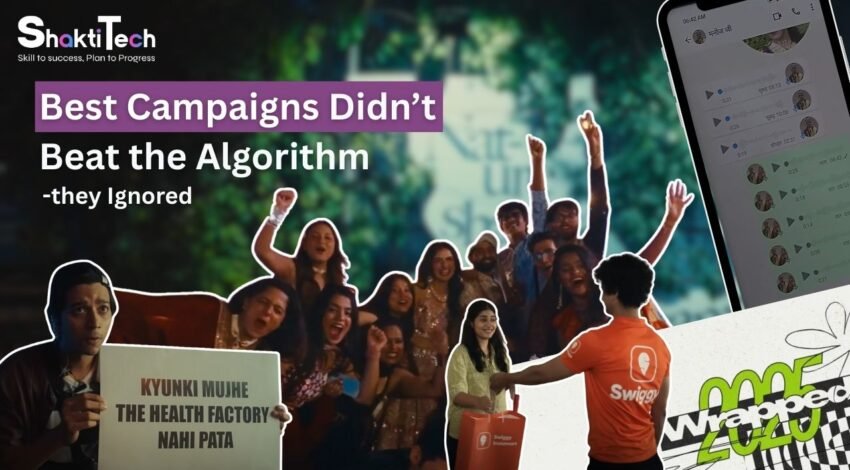
Swiggy Instamart’s “Groom? Broom?” campaign was one such instance. The movie expanded on a tiny, universally relatable error—a typo—just enough to make it memorable. The humor fulfilled the brand promise without detracting from it. One thing was evident from the concept without further explanation: if you ask for something, they will give it to you.
Spotify Wrapped persisted in doing what most brands find difficult: transforming data into identity. Wrapped acknowledged the very personal nature of music.
With “Nature Shapes Britannia,” Britain adopted a more subdued and orderly approach. The company lets nature take the lead rather than making a big deal out of sustainability. Instead of overwhelming existing trees, outdoor installations were tailored to them. The message was illustrated rather than stated. That restraint was important in an environment where audiences are skeptical.
The Health Factory discussed everyday nutrition in a very different way by using humor and role reversal. The brand avoided preaching by allowing younger voices to steer the story, even educating a fitness icon. The product message struck a chord because it was relatable rather than educational.
Then came Zepto’s “Fake Shaadi.” What made it powerful wasn’t just the idea, but how it unfolded. It wasn’t designed as a single moment. It became a live cultural interaction, shaped by creators, partners, and audience participation. No discounts. No forced urgency. Just relevance, playing out in real time.
These campaigns didn’t follow one format or tone—but they shared a mindset.
They weren’t rushed.
They didn’t over-explain.
They didn’t try to be universally liked.
Instead, they trusted the audience to understand the point without being guided step-by-step. They prioritized judgment over optimization and clarity over clutter.
In a year when much of marketing felt engineered, this work felt considered.
What This Says About the Direction of Marketing?
The industry will keep moving faster. The pressure to produce more will only increase.
But 2025 quietly reminded us of something important.
People don’t remember what tries hardest to impress them.
They remember what feels honest.
What understands them?
What doesn’t rush them?
The campaigns that stayed with us didn’t ask, Will this perform?
They asked, Does this feel right?
And that, perhaps, is what good marketing has always looked like.
In the end, 2025 reminded us that attention isn’t won by trying harder — it’s earned by choosing better.
The campaigns people remember aren’t the loudest or fastest. They’re the ones that feel honest, well-judged, and unhurried.
Because when everything is competing to be seen, the work that lasts is the work that feels right.


